
Buying & Selling
Most people assume a slow market makes a move harder. In practice it often makes it easier, as long as you sequence it correctly.
Leilani Fong PREC* | Port Moody, Coquitlam & Port Coquitlam | July 2026
Here is why. When you sell first and buy second in a rising market, every week of delay costs you. Prices move away from you while you are packing. In today's market the opposite is true. Active listings across Metro Vancouver sit about 30 percent above the ten year average, which means you have selection and sellers have competition. That gives you room to ask for the completion date you actually need, or to write an offer subject to the sale of your current home.
Worth saying plainly up front, because everything below depends on it. That window may be closing. June sales rose 9.6 percent year over year and, unusually, every property type gained. New listings came in about 6 percent below last June, and active listings were actually down 3.1 percent from a year ago. Inventory is high measured against the ten year norm, not still climbing. The negotiating room described here is real today. It was more real six months ago.
The question is no longer whether you can move. It is which order you move in, and what each order costs you if it goes sideways.
The four ways to sequence a move
There are only four real structures. Everyone's situation lands in one of them, and the right one depends almost entirely on whether you need your sale proceeds to qualify for the new mortgage.
1. Buy first, sell second
You secure the home you are moving into, then list your current place with a completion date that follows.
Works when
You have enough equity or income that your lender will approve the new mortgage without the sale closing first, and you want certainty on the home rather than certainty on the price.
Watch for
You are now a motivated seller on your old place, with a real deadline. That shows in negotiations. Build a realistic price into the plan rather than the number you were hoping for.
Rough cost
Bridge financing runs a few hundred dollars in lender setup plus interest for the overlap days only. On a $500,000 bridge for five days at prime plus three (prime is 4.45 percent as of July 2026), that is roughly $510 in interest plus the setup fee. Bridging is cheap. Panic selling is not.
2. Sell first, buy second
You list, sell, remove subjects, and then shop with a firm number and a firm date in hand.
Works when
You need the sale proceeds to qualify, or you simply want to know exactly what you have to spend before you fall in love with something.
Watch for
Being homeless on paper. You manage this by negotiating a longer completion when you sell, typically 60 to 90 days, which buys you a shopping window without a hotel bill.
Rough cost
Usually nothing extra, and often the strongest position of the four. A buyer with no subject to sale is the buyer sellers want right now.
3. Subject to sale
You write an offer on the new home that is conditional on your current home selling.
Works when
You have found the right home, you cannot carry both, and the listing has been sitting long enough that the seller values a live buyer over a perfect one.
Watch for
Two things, and they are both real. You will usually pay more to get it accepted, because the seller is pricing the risk of taking their home off the market for you. And the seller will almost always attach a time clause, which means they keep marketing the home. If another offer comes in, you get a short notice window to remove your subject or step aside. On a well priced listing you will simply lose to a cleaner offer.
Rough cost
Often a higher purchase price, plus the risk of losing the home entirely. Use it when the alternative is not buying at all.
4. Same day completion
Both transactions complete on the same date. Money from your sale funds your purchase.
Works when
Both deals are firm, both lawyers are lined up, and neither side has a financing question mark. It is common and it works.
Watch for
Order of operations. Your buyer's funds have to land before your purchase can fund, so the day runs on a chain. One late lender wire and you are unpacking in a driveway. Give your lawyer or notary the full picture at least two weeks out, not two days.
Rough cost
No premium, but zero slack. Many people add one or two days of bridge as insurance and consider it money well spent.
The move-up math is better than it has been in years
This is the part most people miss. When the whole market falls, the more expensive property falls further in dollar terms. If you are moving up, the gap you have to finance gets smaller.
Run it on the benchmark prices Greater Vancouver REALTORS published for each of the last two Junes.
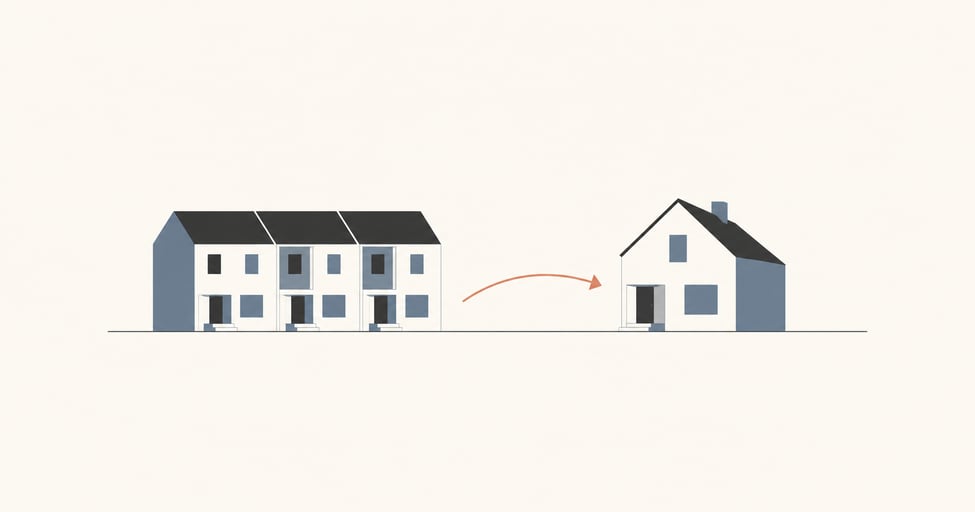
Trading a townhouse for a detached home
Using MLS® Home Price Index benchmark values for Metro Vancouver.
| June 2025 | June 2026 | |
|---|---|---|
| Detached benchmark | $1,994,500 | $1,842,900 |
| Townhouse benchmark | $1,103,900 | $1,046,200 |
| Gap you have to finance | $890,600 | $796,700 |
$93,900
less to bridge than the same trade a year ago
GVR reports year-over-year declines of 7.1 percent for detached and 5.0 percent for townhouses. Those percentages are calculated on revised index values, so they do not reconcile exactly with the published dollar figures above.
You lose about $57,700 on the sale. You save about $151,600 on the purchase. The move costs less even though the headlines say prices are down.
The same logic runs in reverse if you are downsizing, which is worth knowing before you sit down with a spreadsheet. Selling detached and buying a townhouse today releases roughly $94,000 less equity than it would have a year ago. Downsizers have been the group most hurt by this market, and it is why so many are staying put.
Falling markets are expensive for people cashing out and cheap for people trading up. Which one you are decides whether waiting helps you.
What a move actually costs in BC
People budget for the down payment and forget the rest. Here is the realistic list for a purchase in the Tri-Cities, using a $1.2 million example.
| Cost | Typical range |
|---|---|
| Property Transfer Tax 1% on the first $200,000, 2% from $200,000 to $2 million, and 3% above $2 million, plus a further 2% on the residential portion above $3 million, which puts the top marginal rate at 5%. Exemptions exist for first time buyers and some new builds. |
$22,000 |
| Legal fees and disbursements Two transactions means two files. Ask for a package rate. |
$2,000 to $3,500 |
| Home inspection | $500 to $900 |
| Mortgage discharge or penalty Ask your lender whether your mortgage is portable before you do anything else. Porting can eliminate this entirely. |
$0 to $15,000+ |
| Bridge financing If you need it, and only for the overlap days. |
$300 to $1,500 |
| Moving and incidentals | $1,500 to $4,000 |
| Adjustments at completion Prepaid property tax and strata fees owed back to the seller. |
Varies |
The dates that have to line up
A BC contract of purchase and sale carries several dates, and people tend to only look at one of them. All of these need to work together across two transactions.
- Subject removal date. When your conditions come off and the deal becomes firm. Until this passes on your sale, nothing downstream is certain.
- Deposit date. Usually within 24 to 72 hours of subject removal. If your deposit for the purchase is coming from the sale of your current home, that timing has to work, and often it does not. Plan for where the deposit is actually coming from.
- Completion date. When title transfers and money moves. This is the date your two transactions need to coordinate around.
- Possession date. When you get the keys. Usually the day after completion, which gives the lawyers a full business day of runway.
- Adjustment date. The line in the sand for who owes what on taxes, strata fees, and utilities.
The practical version: aim to have your sale firm before your purchase subject removal date. Everything gets easier from there.
Where to start
- Get a real number on your current home. Not an online estimate. A walkthrough and a comparative market analysis, with an honest read on what it will take to sell in the current inventory.
- Confirm your borrowing position. Ask your lender or broker two questions: can I qualify without selling first, and is my current mortgage portable.
- Decide which risk you would rather carry. The risk of not finding a home in time, or the risk of not selling at your number. You are choosing one. Everyone does.
- Pick your sequence before you start shopping. Falling for a listing before you have a plan is how people end up writing a subject to sale offer they did not want to write.
If you have been waiting for a signal, the useful one is not the price index. It is the number of homes you get to choose from. That number is still large. It is no longer growing.
Not sure which order to move in?
I work with clients across Port Moody, Coquitlam, Port Coquitlam and Greater Vancouver on move-up, downsize, and simultaneous transactions. We will look at your equity, your timeline, and your appetite for risk, then map the sequence that fits.
Book a free consultationMarket figures are drawn from Greater Vancouver REALTORS® MLS® Home Price Index data for June 2026. Prime rate as of July 2026. June 2025 benchmarks are as published in GVR's June 2025 report. MLS® HPI values are revised over time, so year-over-year percentages reported today are calculated on revised index values and will not reconcile exactly with the published dollar figures above. This article is general information, not legal, tax, or mortgage advice. Costs and contract terms vary by transaction. Speak with your lawyer, notary, and mortgage professional about your specific situation.